
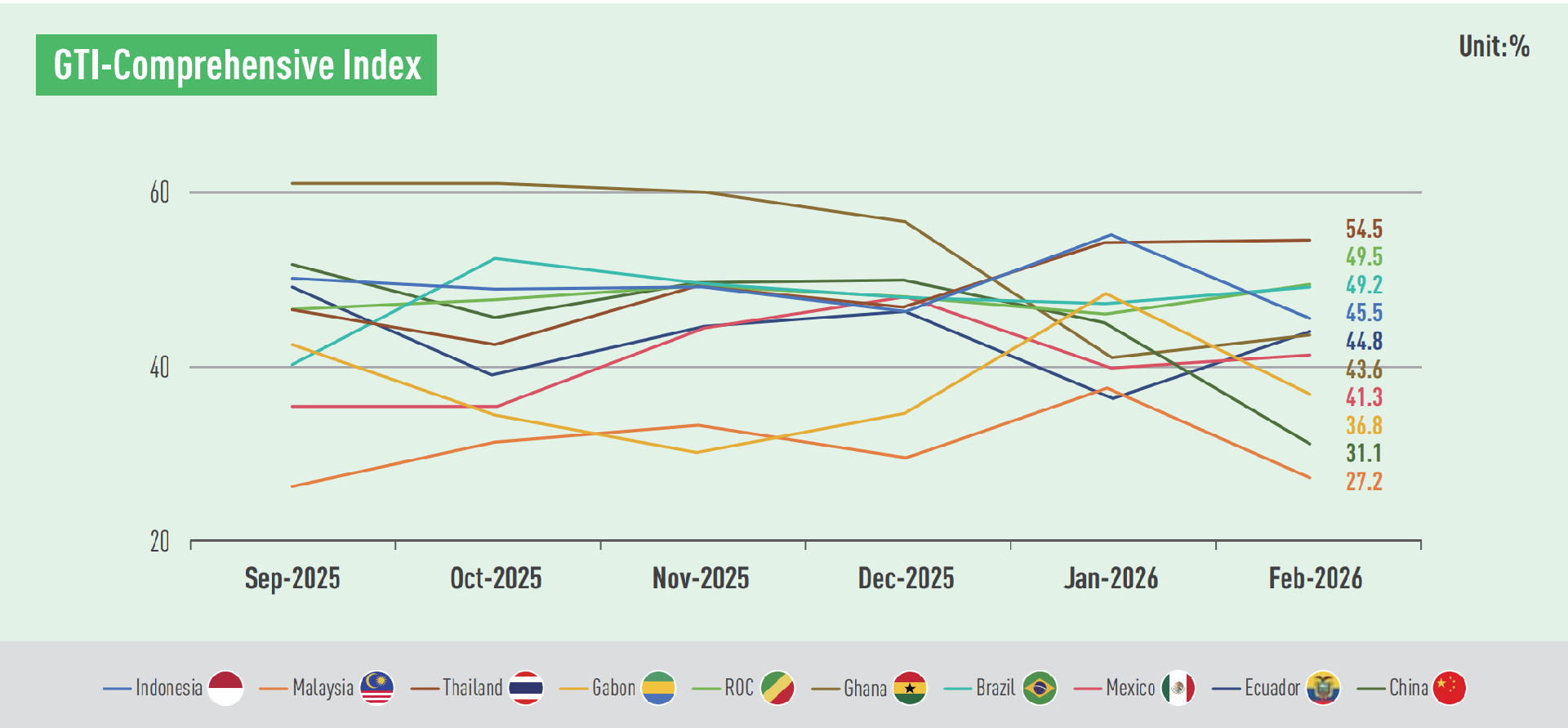
The Global Timber Index (GTI) Report for February 2026 reveals that Thailand, with a GTI reading of 54.5%, remained in expansion territory above the 50% critical value for the second consecutive month, making it the only one of the ten pilot countries to report growth this month. The other nine GTI pilot countries all registered contraction. The Republic of the Congo (49.5%) and Brazil (49.2%) posted readings near the critical value, indicating slight contraction. Indonesia (45.5%), Ecuador (44.8%), Ghana (43.6%), and Mexico (41.3%) showed moderate contraction. And Gabon (36.8%), China (31.1%), and Malaysia (27.2%) recorded a significant downturn. In China's case, timber enterprises experienced a notable slowdown in production and operations due to an extended Spring Festival holiday.
A closer look at the GTI sub-indices highlights bright spots in Latin America this month. Mexico reported an increase in harvesting volume, and Brazil and Ecuador saw a stabilization after previous declines. In terms of new orders, both Brazil and Ecuador registered growth, with a particularly strong uptick in export orders, while Mexico's export market remained stable. Positive signs emerged in some parts of Africa and Asia as well. For instance, harvesting volume grew in the Republic of Congo, and Thailand maintained its momentum with both production and new orders increasing for the second consecutive month.
However, GTI sample enterprises still faced challenges such as weak market demand, unstable raw material supply, and rising operational costs. And heavy rainfall in Indonesia, Ecuador, and Gabon during February disrupted harvesting and transportation activities, underscoring the critical importance of climate resilience for sustainable operations.
This month's report also highlighted pathways toward high-value utilization of wood resources. In Brazil's construction sector, engineered wood, as a low-carbon alternative, can reduce CO₂ emissions by up to 80% per square meter when compared to conventional concrete and masonry structures, while also offering advantages such as less energy required during processing, strong carbon sequestration capacity, and efficient construction. In Gabon, extracts from Okoumé had demonstrated potential in cosmetics and healthcare industries, with the first active ingredient ready for commercialization, thus positioning Okoumé not only as a timber resource for veneer or plywood, but also as a raw material for green chemistry and biotechnology.
On the supply chain governance front, GTI pilot countries had been advancing legal and sustainable frameworks. In Malaysia, the state of Sabah had launched the Sabah Timber Legality Assurance System Plus (TLAS+), which is the first framework in Malaysia to integrate legality checks, deforestation-free rules, and voluntary sustainability standards under a single structure. In Ghana, since the issuance of the first FLEGT license in 2025, over 400 licenses had been issued, indicating substantive work had begun. Meanwhile, the government of the Republic of the Congo had been systematically advancing the sustainable management of its forest concessions. Currently, 32 concessions covering more than 10.5 million hectares are under sustainable management, accounting for 85% of total area allocated for forest exploitation.
| E-mail:ggsc@itto-ggsc.org | Tel:86-10-66095281 |


Sigh Up for Emails |
|
