

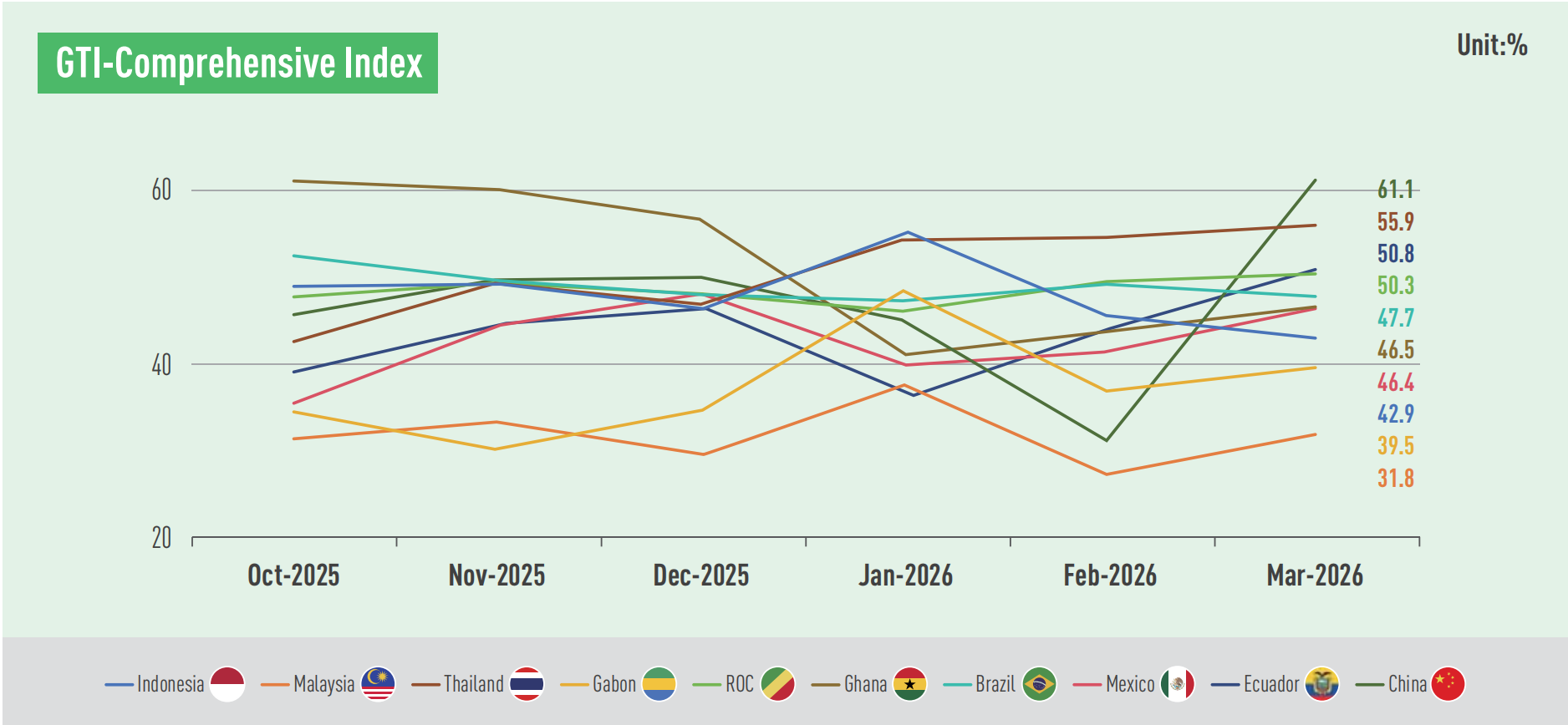
The Global Timber Index (GTI) Report for March 2026 reveals that the overall performance of timber sectors in the pilot countries improved this month. Among the ten pilot countries, four—China, Thailand, Ecuador, and the Republic of the Congo—recorded GTI readings above the 50% critical value, at 61.1%, 55.9%, 50.8%, and 50.3% respectively, indicating an upward trend in their timber sectors. The other six countries were in contraction territory. Brazil (47.7%), Ghana (46.5%), and Mexico (46.4%) posted readings close to the critical value, reflecting relatively moderate contraction, while Indonesia (42.9%), Gabon (39.5%), and Malaysia (31.8%) recorded significantly lower readings, thus pointing to a notable slowdown in their timber sectors.
The GTI sub-indices indicated that pilot countries in Asia performed relatively well this month. Harvesting volume increased in both Indonesia and Thailand compared to the previous month, while production volume and new orders rose in Thailand and China. Although Malaysia continued to experience contraction across most production and business segments this month, the declines in production volume and new orders eased somewhat.
In March, heightened tensions in the Middle East drove up fuel prices in most GTI pilot countries, leading to higher costs for timber harvesting, domestic transport, processing, and export logistics. Some timber enterprises also experienced disruptions to shipping routes and delays in deliveries, and in some cases, orders were canceled or put on hold. In response to these shocks, timber sectors in the pilot countries adopted proactive measures, including collaborating with governments to diversify export markets, actively exploring markets in neighboring countries to help control logistics costs, seeking alternative transport routes to mitigate the impact of detours and surcharges on delivery schedules and costs, negotiating contract adjustments with customers to address rising cost pressures, and calling on governments to lower or stabilize fuel prices and to provide subsidies and tax relief.
While navigating the new challenges, timber sectors in GTI pilot countries continued to advance their traceability systems. To comply with the EU Deforestation Regulation (EUDR), the Thai government instructed relevant agencies to accelerate the development of traceability mechanisms and raw-material origin certification systems that meet EU standards, thereby ensuring the competitiveness of Thai products. In Gabon, on March 12, the Ministry of Water and Forests, Environment, Climate announced the establishment of a national data center to ensure full traceability of logs from forest sites to export ports, including GPS tagging before felling, measurement of harvesting volume, and monitoring of timber sent to processing plants, processed and exported.
| E-mail:ggsc@itto-ggsc.org | Tel:86-10-66095281 |


Sigh Up for Emails |
|
