

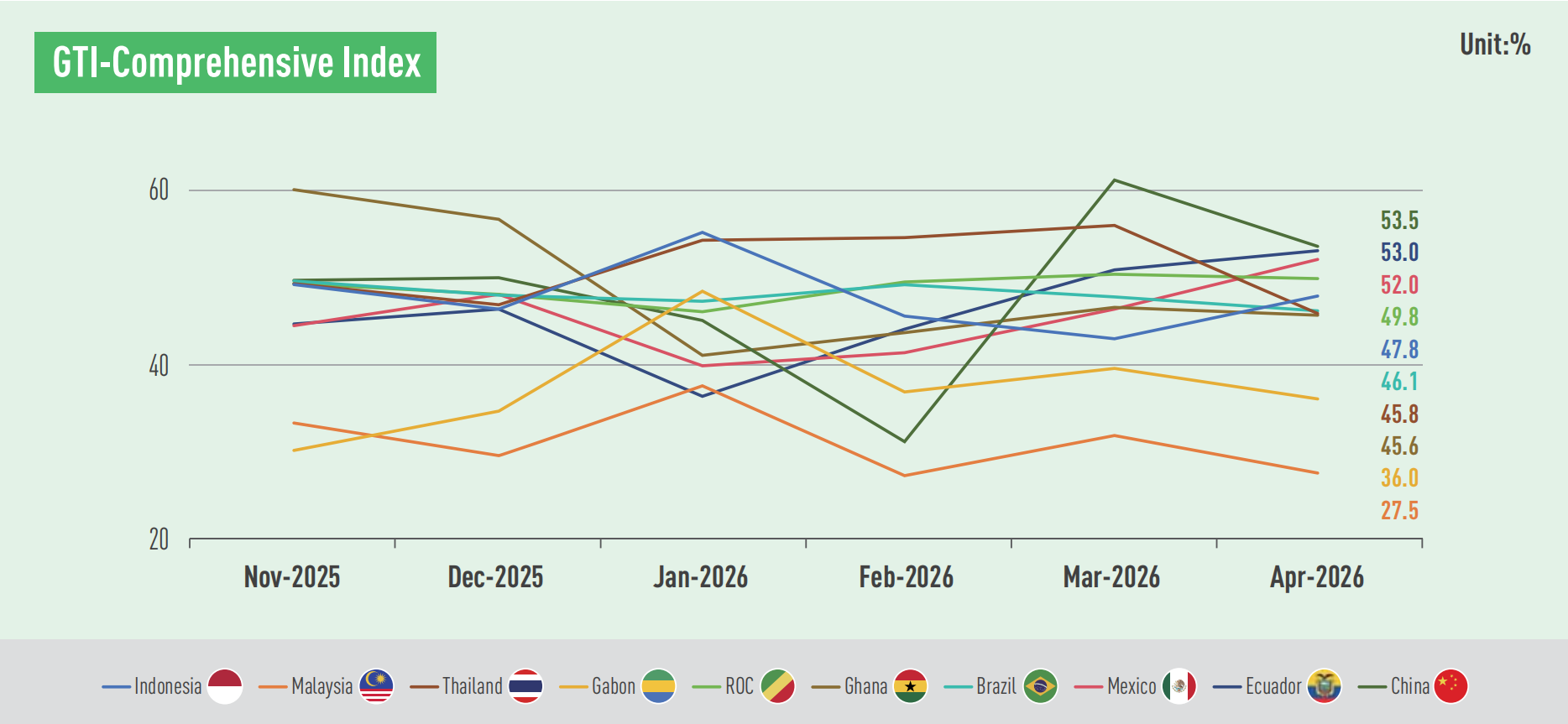
The Global Timber Index (GTI) Report for April 2026 reveals that among the ten pilot countries, China (53.5%), Ecuador (53.0%), and Mexico (52.0%) recorded GTI readings above the 50% critical value, indicating an overall upward trend in their timber sectors. Other countries were in contraction territory: the Republic of the Congo (ROC) posted a reading of 49.8%, close to the critical value, indicating slight contraction; Indonesia (47.8%), Brazil (46.1%), Thailand (45.8%), and Ghana (45.6%) showed moderate contraction; and Gabon (36.0%) and Malaysia (27.5%) recorded notably low readings, reflecting a significant downturn in their timber sectors.
The GTI sub indices revealed that harvesting volume in Mexico rose compared to the previous month, while Brazil maintained stable harvesting for the third consecutive month. On the production side, Gabon, Ecuador, and China all showed gains. On the demand side, new orders increased in Mexico, Ecuador, and China, and the Congo saw new orders remain stable for the third consecutive month, with both domestic and international markets running relatively steadily.
High costs stood out as a major challenge for GTI sample enterprises. Although fuel prices in several countries declined this month, they remained at historically high levels, placing considerable cost pressures on timber transport, harvesting, and other activities. At the same time, cost pressures from raw materials, labor, electricity, and taxes further squeezed profit margins. In response, some governments have proactively introduced supportive measures. For example, the Malaysia’s Sarawak government approved a 50% reduction in royalty rates and selected statutory charges for natural forest timber, in an effort to ease cost burdens on the industry.
GTI pilot countries continued to see dynamic shifts in timber trade. Affected by tensions surrounding the Strait of Hormuz, timber trade between pilot countries and Middle Eastern nations dropped sharply. Taking Brazil as an example, its timber exports to the Middle East plummeted from nearly US$18 million in January to roughly US$6 million in March. In the Americas, Brazil’s timber sector saw a decline in exports to the United States and an increase in exports to Mexico, reflecting its active efforts to find alternative markets within the Americas.
In terms of forest governance, new developments in pilot countries this month centered on the areas such as livestock-related deforestation prevention, technological empowerment, and community based participatory governance. For instance, in Mexico, with support from the Food and Agriculture Organization of the United Nations (FAO) and the Global Environment Facility (GEF), Mexico is advancing its first national policy for deforestation-free, low-emission livestock production, so as to address forest loss driven primarily by cattle ranching. In Peninsular Malaysia, the Forestry Department has introduced advanced technologies—including artificial intelligence, geographic information systems, and drones—to enhance its efforts to combat illegal logging. In Thailand, the government is advancing the legislative process of the draft Community Forest Act, which aims to empower local residents to derive benefits while protecting forest areas.
| E-mail:ggsc@itto-ggsc.org | Tel:86-10-66095281 |


Sigh Up for Emails |
|
