

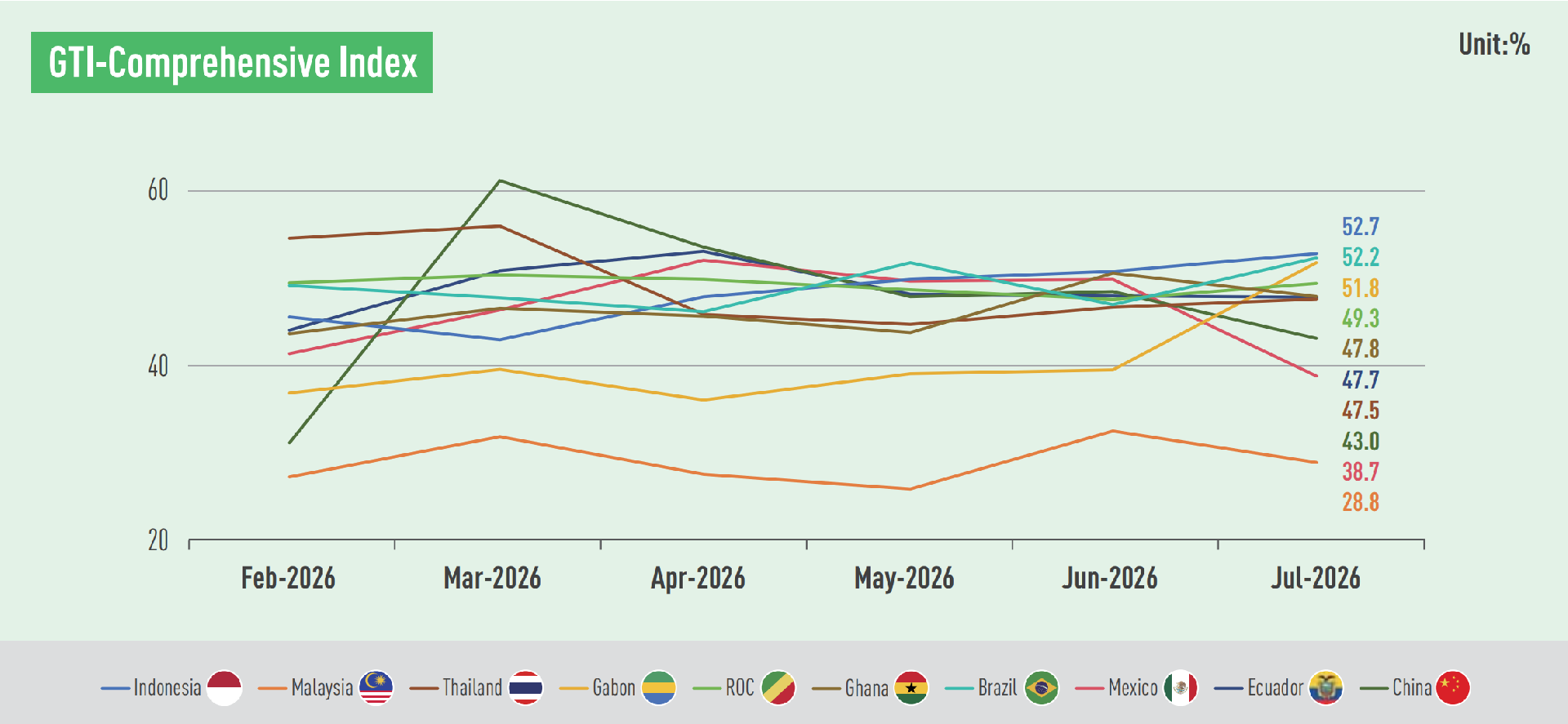
The Global Timber Index (GTI) Report for July 2026 revealed that among the ten GTI pilot countries, three countries—Indonesia (52.7%), Brazil (52.2%), and Gabon (51.8%)—registered GTI readings above the 50% critical value, indicating a slight overall expansion in their timber sectors compared to the previous month. The other seven countries were in contraction territory: the Republic of the Congo (49.3%) posted readings close to the critical value, indicating slight contraction; Ghana (47.8%), Ecuador (47.7%), Thailand (47.5%), and China (43.0%) showed moderate contraction; and Mexico (38.7%) and Malaysia (28.8%) recorded low readings, reflecting a significant downturn in their timber sectors.
Sub-indices revealed that Brazil’s harvesting volume increased month-on-month, while Indonesia’s harvesting activities remained stable over the past three months. Overall performance on the production side was positive: production volume rose in Indonesia, Thailand, Gabon, and Brazil this month, and Ecuador’s production volume, after three consecutive months of growth, held steady over the past two months. On the demand side, new orders for both Indonesia and Brazil grew for the third consecutive month, while the orders for Gabon and the Republic of the Congo stabilized after earlier declines.
GTI pilot countries continued to advance work on plantation development and securing timber raw material supply. Ecuador currently has approximately 172,000 hectares of commercial plantations, supplying the domestic market as well as export markets such as China, the United States, Peru, Colombia, and India. Brazil is actively expanding its planted forest area and has about 40 million hectares of degraded land suitable for productive restoration, providing room to increase supplies of renewable timber.
At the same time, some countries have strengthened government-enterprise collaboration to accelerate expansion into international markets. For example, the Malaysian government has used a digital trade platform to help the furniture industry expand into international markets; the Indonesian government aims to open new market access for furniture products through various international trade agreements. In response to U.S. tariff barriers, Brazil’s furniture industry has strengthened its market diversification strategy, achieving growth in furniture exports to several Latin American markets.
| E-mail:ggsc@itto-ggsc.org | Tel:86-10-66095281 |


Sigh Up for Emails |
|
