

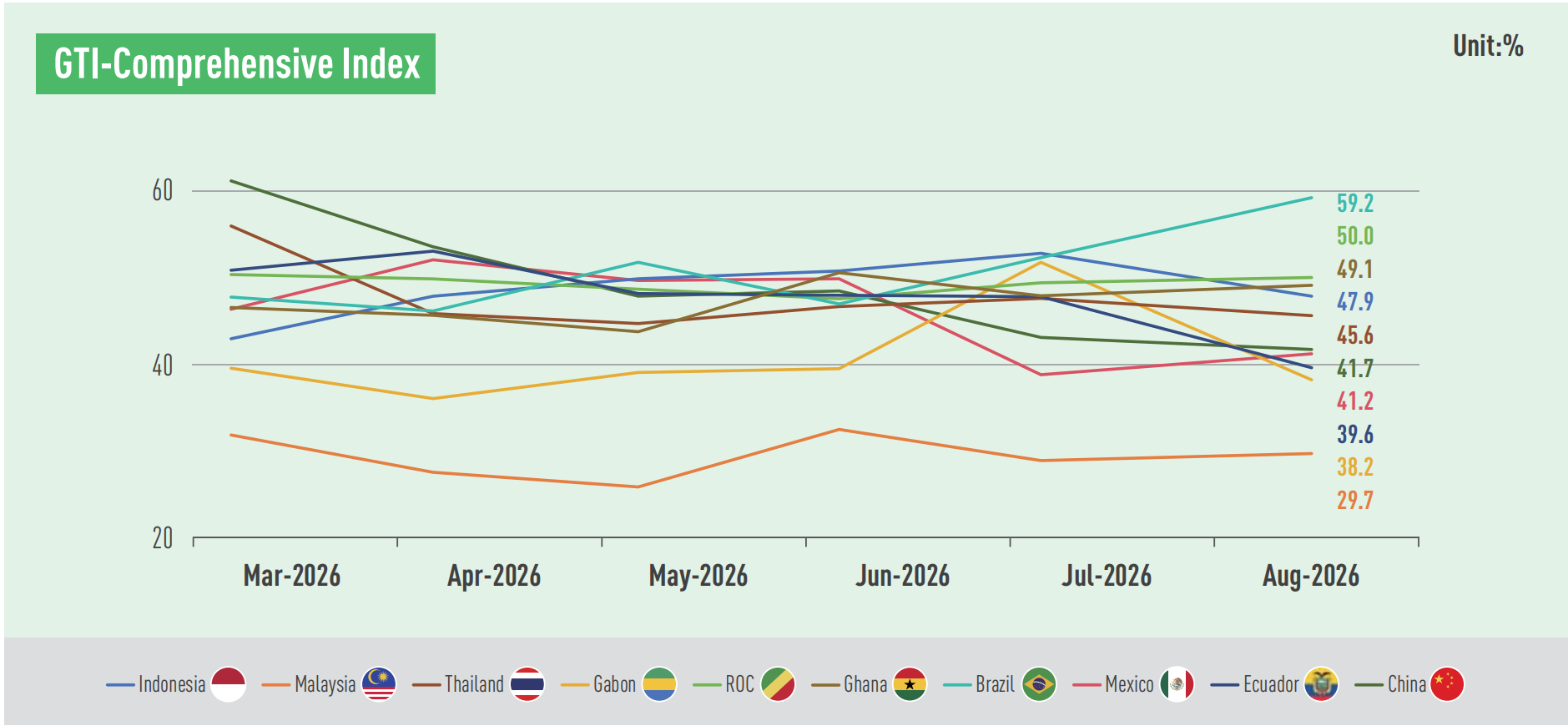
The Global Timber Index (GTI) Report for August 2026 revealed that among the ten GTI pilot countries, Brazil (59.2%) continued to register a GTI reading above the 50% critical value, indicating an overall expansion in its timber sector; the Republic of the Congo (50.0%) posted a reading at the critical value, signaling a stable sector; and the other eight countries were in contraction territory. Among them, Ghana (49.1%) and Indonesia (47.9%) recorded readings close to the critical value, indicating slight contraction; Thailand (45.6%), China (41.7%), and Mexico (41.2%) showed moderate contraction; and Ecuador (39.6%), Gabon (38.2%), and Malaysia (29.7%) recorded low readings, reflecting a significant downturn in their timber sectors.
Sub-indices revealed signs of partial stabilization and improvement. On the harvesting side, Brazil and Indonesia recorded month-on-month increases in harvesting volume, the Republic of the Congo halted its decline and stabilized, and contraction eased in Ghana and several other countries. On the production side, Brazil maintained growth for a second consecutive month, Indonesia’s production remained steady over the past five months, and Mexico’s production contraction eased markedly. On the demand side, Brazil’s new orders rose for the fourth straight month and the Congo’s orders held steady; China’s new orders softened, but its export market stabilized after earlier declines.
In response to external market pressures, several countries have accelerated adjustments to their trade strategies. China is pursuing greater diversification of furniture exports, actively expanding into Middle Eastern, Southeast Asian, and Latin American markets. Indonesia is establishing a task force to pursue its target of USD 6 billion in furniture and craft exports by 2031. Gabon focuses on expanding timber markets within Africa, while Ecuador’s teak industry is shifting toward higher-value-added products to capture new market opportunities. Addressing compliance requirements of EU Deforestation Regulation (EUDR), Indonesia is preparing a pilot project to build a compliance model that suits its domestic conditions while still meeting the standards required by the European Union. Ecuador is working on a national balsa strategy to strengthen mechanisms for traceability and legality, thereby maintaining the products’ access to international markets.
| E-mail:ggsc@itto-ggsc.org | Tel:86-10-66095281 |


Sigh Up for Emails |
|
