
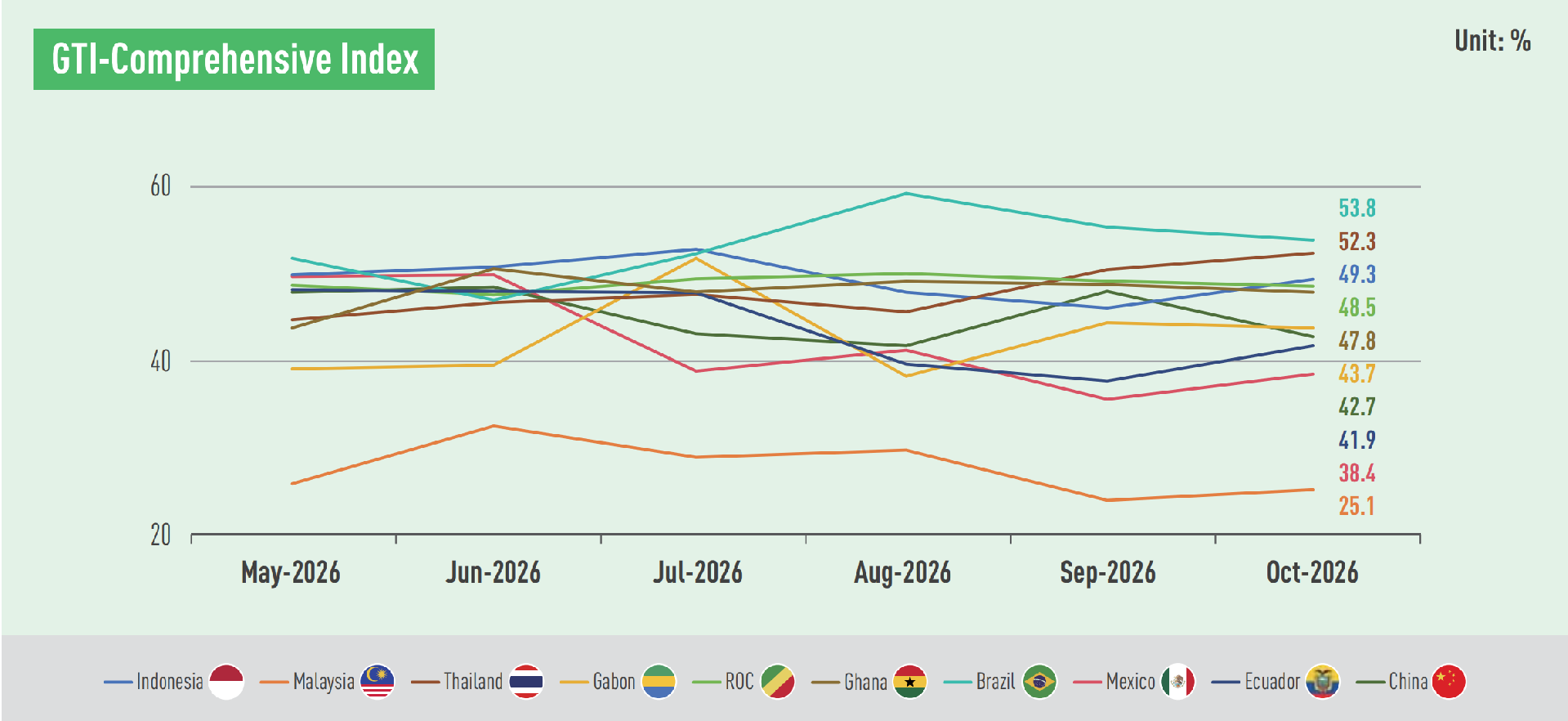
The Global Timber Index (GTI) Report for October 2026 revealed that among the ten pilot countries, Brazil (53.8%) and Thailand (52.3%) maintained GTI readings above the 50% critical value for the fourth and second consecutive month respectively, indicating an overall expansion in their timber sectors. The other eight countries were in contraction territory: Indonesia (49.3%), the Republic of the Congo (48.5%) and Ghana (47.8%) posted readings close to the critical value, indicating slight contraction; Gabon (43.7%), China (42.7%) and Ecuador (41.9%) showed moderate contraction, with China's reading declining from the previous month due to factors such as the National Day holiday; and Mexico (38.4%) and Malaysia (25.1%) recorded low readings, indicating a significant downturn.
GTI sub-indexes showed that harvesting activity in Brazil was stable this month and had been generally steady over the past ten months. Production in Thailand shifted from stable to increasing, while production activity in both Gabon and Brazil showed signs of stabilization. On the demand side, new orders increased in Indonesia, Thailand and Brazil. Notably, Brazil's new orders rose for the sixth consecutive month, with particularly strong performance in export markets.
In October, weather conditions emerged as a prominent factor affecting timber production and operations in many pilot countries. This was also an important reason why none of the countries recorded an increase in harvesting volume this month. In Asia, several Thai enterprises reported difficulties in transporting logs and other raw materials due to flooded roads and persistent rainfall. In Africa, the Republic of the Congo had entered the rainy season; adverse weather combined with poor road conditions restricted harvesting and logistics. Rainfall also disrupted timber industry activities in all three Latin American pilot countries. Indonesia, however, faced different weather-related challenges: prolonged dry weather conditions caused a sharp decline in river water levels, severely disrupting water-based logistics, while haze and extreme heat impacted visibility and operational efficiency. In response to these weather-related challenges, GTI sample enterprises recommended strengthening natural disaster risk management, diversifying suppliers, sourcing raw materials from regions less affected by weather, and flexibly adjusting production and distribution targets in response to weather conditions. Meanwhile, they called on governments to increase road maintenance efforts and improve logistics efficiency to enhance the industry’s ability to cope with climate risks and ensure continuity of production.
GTI pilot countries continued to advance preparations for the EU Deforestation Regulation (EUDR). On 27 October, Thailand's Deputy Prime Minister chaired an EUDR meeting, which approved the use of National EUDR Single Window (NESW) platform to facilitate the implementation of traceability and some other matters. Designed to comply with EUDR requirements, the NESW system covers seven designated categories, including timber, and can generate due diligence reports (DDRs) and datasets containing geographic coordinates. In Ghana, the Forestry Commission (FC) and other organizations jointly hosted a national policy dialogue focusing on strengthening Ghana’s readiness for EUDR. The FC Chief Executive stated at the event that Ghana is actively strengthening its institutions and traceability systems to meet the requirements, and urged stakeholders to view EUDR as an opportunity to modernize production systems, attract responsible investment, and enhance the competitiveness of Ghanaian products. In addition, the Brazilian Association of Mechanically Processed Timber Industry (ABIMCI) has initiated discussions with the Brazilian Confederation of Agriculture and Livestock (CNA) on the implementation of EUDR. Among the initiatives under consideration is the use of the Agro Brasil + Sustainable platform, developed by the Brazilian Ministry of Agriculture and Livestock (MAPA), as a tool to standardize and centralize traceability and compliance information for Brazilian supply chains subject to European requirements.
| E-mail:ggsc@itto-ggsc.org | Tel:86-10-64022535 |


Sigh Up for Emails |
|
