

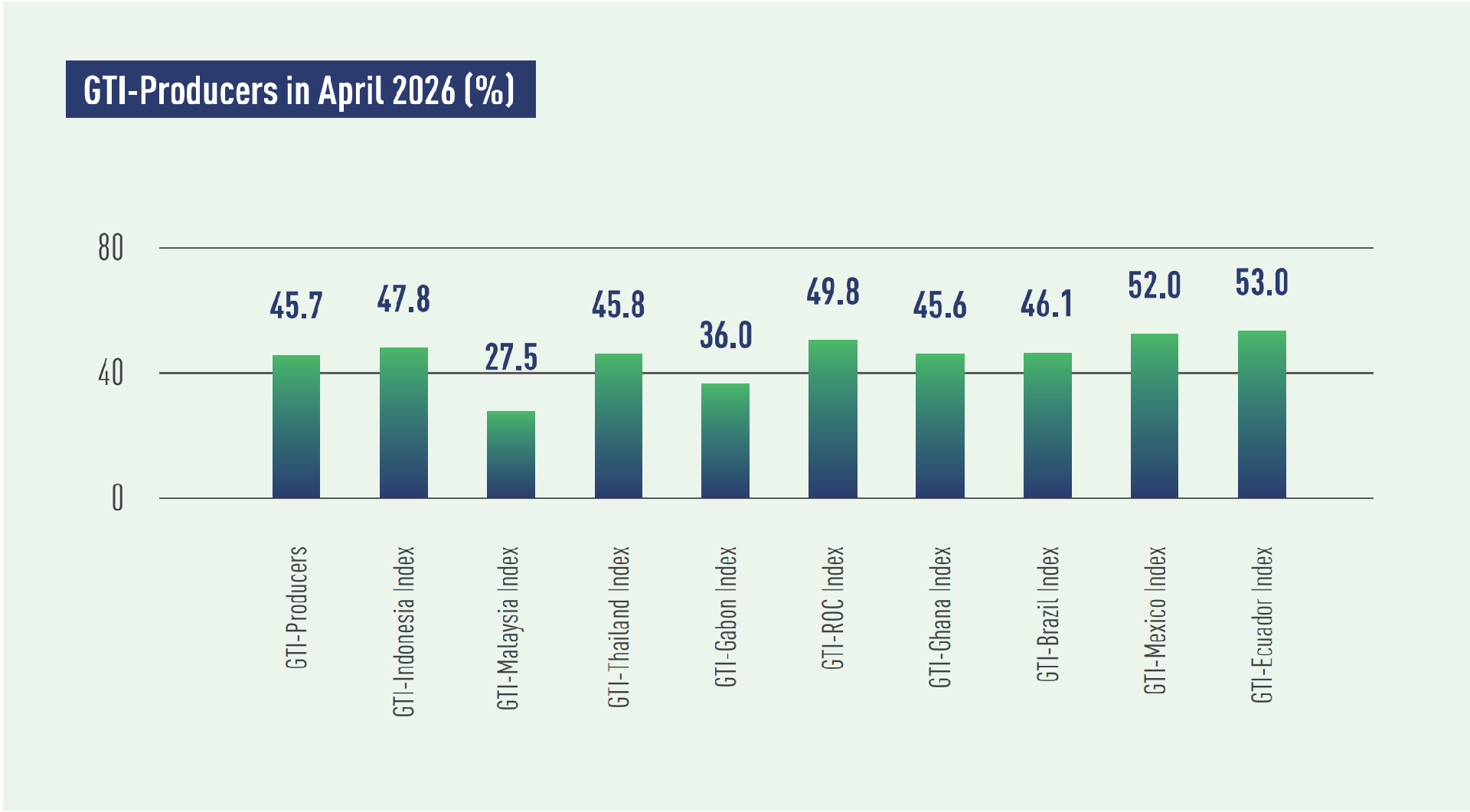
In April 2026, the GTI-Producers registered 45.7%, a decrease of 0.3 percentage point from the previous month and below the critical value (50%) for several consecutive months, indicating a continued downturn for the timber harvesting and primary processing industries in the pilot producing countries.
In Asia, the GTI indices for Indonesia, Thailand, and Malaysia came in at 47.8%, 45.8%, and 27.5%, respectively, all in contraction territory below the 50% critical value. This month, harvesting volumes in Indonesia and Thailand shifted from last month’s growth to decline. Malaysia saw its harvesting shrink for several consecutive months, and its sample enterprises advised domestic manufacturers to strengthen raw material reserves. On the production front, Indonesia’s output stabilized after two months of decline, Thailand’s production volume held steady following three months of growth, and Malaysia’s production continued to contract. Overall, harvesting activity weakened across all three countries, and the only positive signal on the production side was Indonesia's stabilization after months of decline, suggesting that the overall supply side of Asia's pilot producers was under considerable pressure. On the demand side, new orders decreased in all three countries, though Indonesia and Thailand experienced only slight drops.
In Africa, the GTIs for the Republic of the Congo (ROC), Ghana, and Gabon stood at 49.8%, 45.6%, and 36.0%, respectively, all in contraction territory. Harvesting volumes also declined in all three African countries this month. In the Congo, harvesting turned from stable level to a slight decrease; in Ghana, the contraction in harvesting eased; and in Gabon, the drop was sharper in April, when heavy rains significantly affected its harvesting and transport activities. On the production side, output remained stable in the Congo, saw four month declines in Ghana, and turned from decline to growth in Gabon. When viewed alongside orders, this month, the production and business activities in the Congo were relatively stable overall, Ghana experienced weakness in both supply and demand, while Gabon saw production expand amid sluggish demand.
In Latin America, the GTIs for Ecuador, Mexico, and Brazil stood at 53.0%, 52.0%, and 46.1%, respectively, indicating that the timber sectors in Ecuador and Mexico were in expansion territory, and overall, the Latin America performed relatively well this month. In terms of harvesting, Ecuador saw its volume shift from growth to decline. Mexico, despite a long Holy Week holiday, posted an increase in harvesting volume, with only a slight decline in March over the past three months. Brazil’s harvesting volume remained stable for the third consecutive month, though its sample enterprises reported insufficient raw material supply in the country’s timber sector. On the production side, Ecuador’s output continued to grow, while Mexico and Brazil saw declines. Demand was the standout performer: new orders increased in both Ecuador and Mexico compared to the previous month, and Brazil’s overall new orders held steady, supported by export markets.
| E-mail:ggsc@itto-ggsc.org | Tel:86-10-66095281 |


Sigh Up for Emails |
|
