

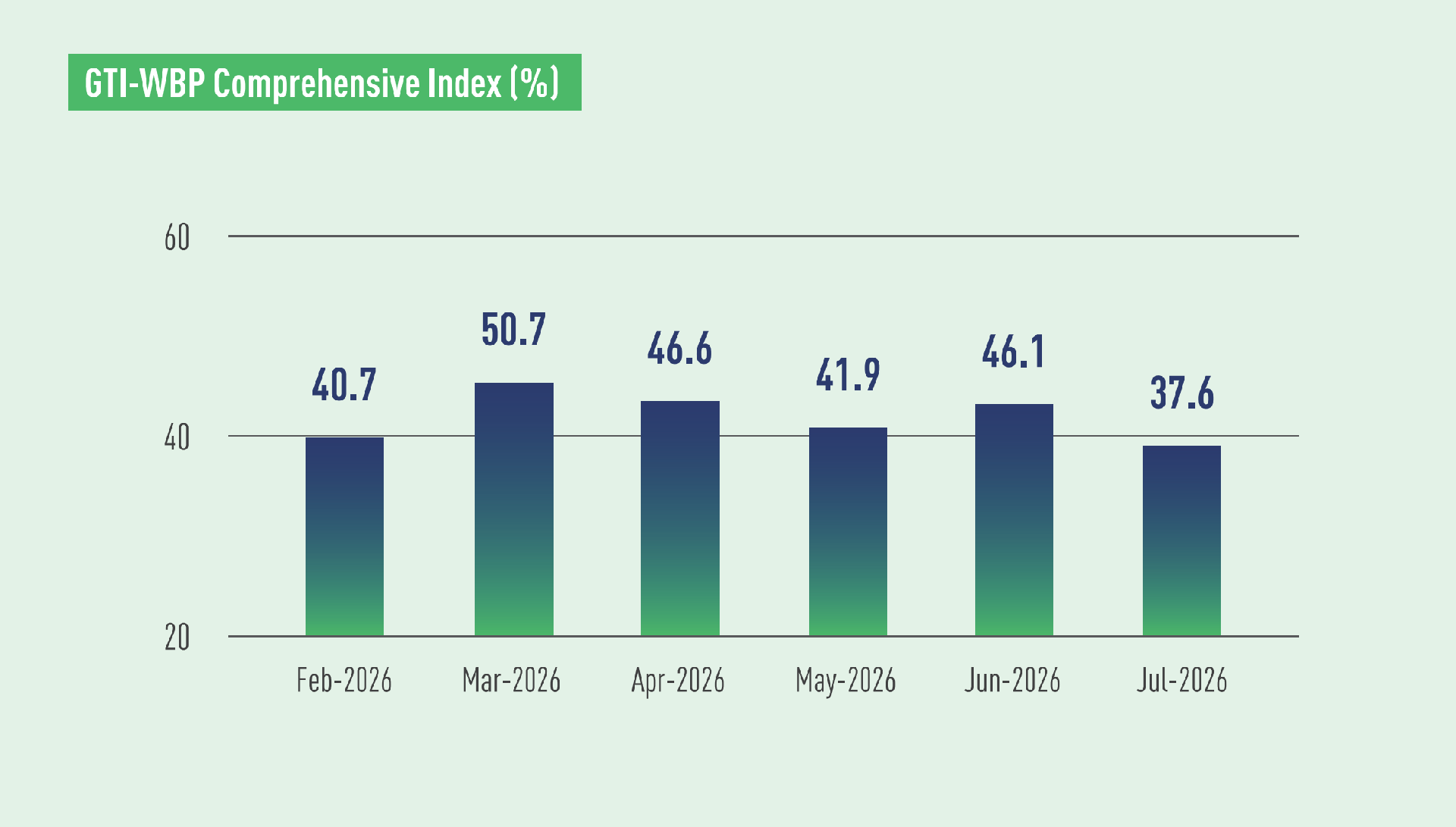
In July 2026, the GTI-Woodbased Panel (GTI-WBP) Index registered 37.6%, a decrease of 8.5 percentage points from the previous month and below the critical value (50%) for four consecutive months, indicating that in the pilot countries, the overall business prosperity of wood-based panel industry represented by the index shrank from the previous month.
On the demand side, overall market demand for wood-based panels weakened notably this month. The new orders index came in at 34.1%, plunging 11.6 percentage points from the previous month. The export orders index stood at 39.0%, down 3.9 percentage points, while the existing orders index registered 44.3%, ticking up 2.9 percentage points month on month yet remaining in contraction territory.
On the supply side, the production index recorded 39.3%, marking its fourth consecutive month below the 50% critical value and falling 5.2 percentage points from the previous month—a clear sign that overall capacity continued to shrink. Affected by both weak demand and cost pressures, most manufacturers maintained a cautious production strategy, with some forced to lower operating rates. Meanwhile, the inventory index of finished products came in at 53.4%, up 1.7 percentage points from the previous month and remaining above the 50% critical value for three consecutive months. This indicates that the WBP market was oversupplied this month, with the pressure of inventory backlog continuing to intensify.
On the price front, the purchase price index for raw materials registered 59.2%, staying above the critical value for several consecutive months, suggesting that prices for logs and other related raw materials continue to trend upward, keeping production costs persistently high. Environmental concerns also compounded raw material cost pressures for some manufacturers. In China, for instance, a growing number of manufacturers are switching to formaldehyde-free or low-formaldehyde eco-friendly adhesives, which cost three to four times as much as traditional adhesives, directly lifting unit production costs. While raw material prices rose, many WBP manufacturers grappled with high energy prices and logistics expenses, prompting the manufacturers in some countries to collectively raise ex-factory prices.
Main updates related to the wood-based panel market include: According to industry monitoring data from the Development Planning Institute of China's National Forestry and Grassland Administration, in the first half of 2026, China's plywood and fiberboard industries saw a slight decline in the number of enterprises while total production capacity remained broadly stable; the particleboard industry, by contrast, experienced a slight drop in the number of enterprises and a slowdown in total production capacity growth. The GTI-Indonesia Focal Point reported that in July, demand from Asian markets continued to provide relatively stable support for Indonesian plywood export activities, while the U.S. market remained subject to uncertainty related to trade policy measures affecting Indonesian plywood. In other news, Brazil's tropical plywood exports in June rose 40.0% in volume to 4,200 m3, and increased 47.0% in value to US$2.5 million.

| E-mail:ggsc@itto-ggsc.org | Tel:86-10-66095281 |


Sigh Up for Emails |
|
